
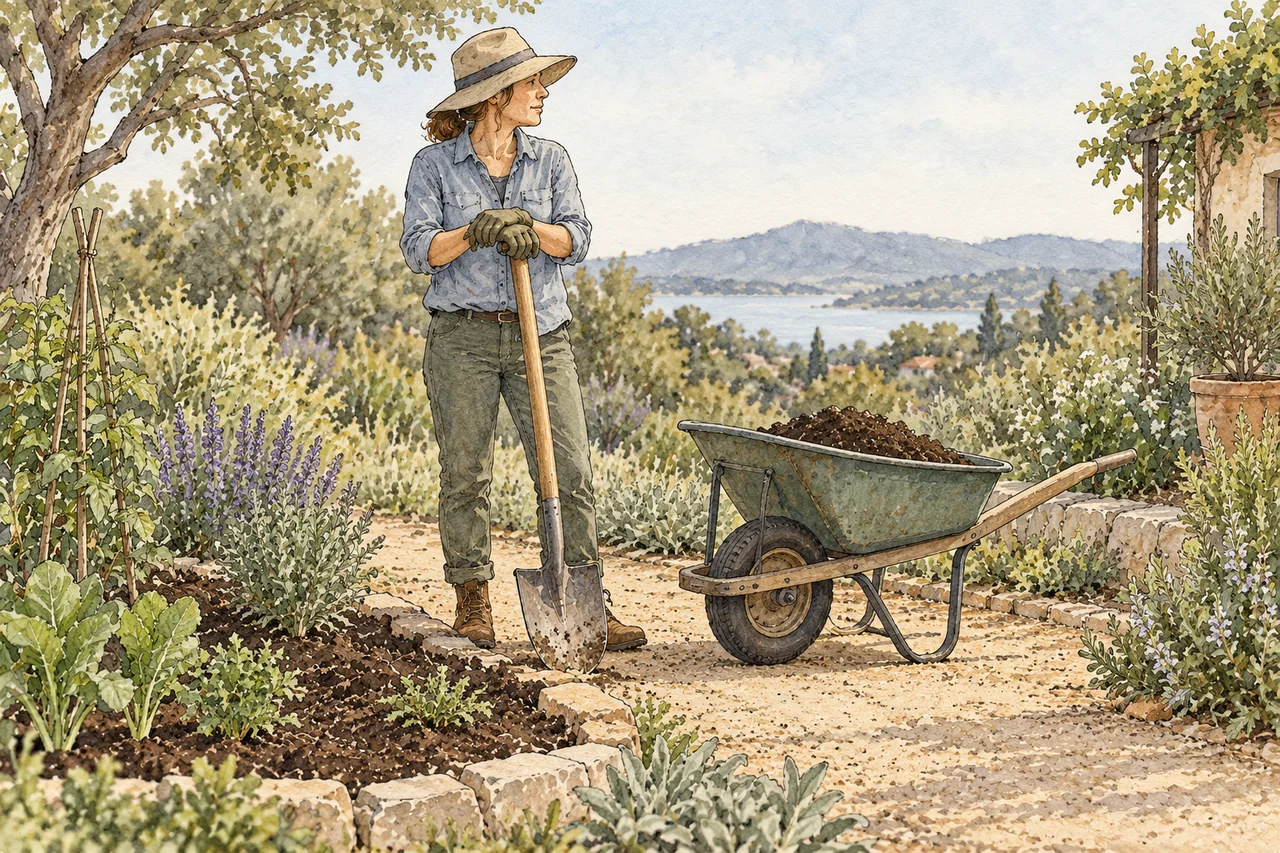
Make the work flow in one direction
Hand digging gets easier when the next movement is obvious. Loosen the soil, collect a manageable amount, and place it where it needs to go. Walking around a pile, lifting the same material twice and fighting a jammed blade all spend effort without improving the job.
Before working, complete the service checks described in planning a dig. Clear the work area and choose a stable route for moving soil. Keep tools and spoil out of that route.
Place the receiving pile or wheelbarrow close enough that you do not have to stretch or throw every load. Keep it safely back from any excavation edge. Where you can, work through the area in a sequence that leaves finished ground behind you and unworked ground ahead.
This is especially useful in a small bed. If you loosen the whole site at once and then walk across it carrying dirt, you can compact the soil you just prepared. Decide where your feet and wheels will travel.
Separate cutting from lifting
Use a suitable spade or digging shovel to take a modest slice. Where the blade has a foot tread, press it with a securely placed boot while staying balanced. If it will not enter with controlled pressure, reduce the bite or change to an appropriate loosening tool.
Free the soil before trying to lift it. A blade trapped in intact ground is asking your handle to do another job. Use a suitable fork or mattock where the ground calls for it, then scoop the material that is already loose.
A small bite beside an exposed edge often releases more easily than an equally deep bite in the middle of untouched ground. Start from a workable edge and advance in narrow slices. For a garden bed, check whether loosening with a fork is enough; turning every layer is not always necessary.
Wet clay can stick to the blade and make each scoop heavier. In a cultivation job, smearing and persistent clods are reasons to wait for better conditions. The RHS and university extension guidance both caution against cultivating wet soil. Adding water indiscriminately is not a universal digging shortcut, especially around excavations or buried services.
Bring the load close and move your feet
Use a stable stance with enough room to step. Hold the tool securely and keep the freed load reasonably close to your body. Turn your feet toward the place you are depositing it instead of twisting your torso while your boots stay planted.
The CCOHS digging guide emphasizes balance, avoiding twisting and adjusting the load for wet soil. It is sensible to begin with less than the blade can carry and increase only if the whole movement remains comfortable and controlled.
Watch the placement as well as the lift. A low, nearby destination asks less of you than a long throw over a high pile. If the pile keeps growing into an awkward target, move the receiving point or switch to a hauling method.
There is no universal safe scoop weight. Tool weight, material, reach, repetition, footing, weather and the individual all change the task. Ergonomic advice is useful, but it does not replace making the job smaller or moving the receiving point closer.
Let the wheelbarrow do a useful share
Check the tire or wheel, handles, tray and fasteners before loading. A damaged wheel or rubbing bearing can turn an easy route into a workout. Use a wheelbarrow suited to the material, with a load you can start, steer and stop.
Keep the load balanced and low. Do not build a tall heap that hides the route or shifts unexpectedly. Several manageable trips are preferable to one trip that you can barely keep upright.
Make the path firm and clear. Soft ground, steps, narrow gates, abrupt edges and steep slopes all change the effort and control required. The HSE's pushing and pulling assessment explicitly considers these route conditions, along with equipment condition. Capacity printed on the tray is not a recommendation for your particular slope.
If the route is poor, fix the route, use a different hauling arrangement or get assistance. Do not balance a loaded wheelbarrow on a makeshift crossing over an open excavation. Think about the return trip too, since a clear loop can be easier than repeated reversing and tight turns.
Work at a pace you can keep
Alternate digging, moving soil and lighter tasks where that changes the physical demand. Take short breaks before fatigue makes you grip harder, reach farther or lose accuracy. Rest is part of getting a job finished well.
In hot weather, schedule demanding work for cooler conditions, keep drinking water nearby and take recovery breaks in a cool or shaded place. NIOSH's heat guidance calls for lighter work and more recovery as conditions and workload become more demanding. A fixed timer alone cannot account for the day's heat.
Stop if you develop pain, dizziness or unusual breathlessness. If an existing health condition makes strenuous work uncertain, get individual advice before taking it on. Shovel Therapy should leave room for enjoyment, not a competition to ignore discomfort.
Check your tools during breaks. A head that has started to move or a shaft that is beginning to split needs attention before the next load. Keep people clear of working and swinging tools.
A small trick from a century ago
Both Bailey's Manual of Gardening (1910) and Rockwell's Home Vegetable Gardening (1911) described making diagonal spade cuts beside already dug ground. Their point was to give one side of the slice an exposed edge, reducing the amount of intact soil that needed separating.
That is a useful observation for a small, cleared garden area. It is not a rule to dig deeper or a reason to work near an unidentified service. Try the principle as smaller, controlled bites and notice how the soil responds.
If progress slows, change one thing
- Blade will not enter: reduce the slice or use the right loosening tool.
- Load is awkward: take less material and move the receiving point closer.
- Wheelbarrow fights you: inspect the wheel and improve the route.
- Soil sticks and smears: reconsider the timing of a cultivation job.
- You keep handling the same dirt: change the spoil layout.
- Fatigue changes your movement: pause, reduce the demand or arrange help.
A short trial can reveal the real bottleneck. Improve that part before committing to hours of the same movement.
Sources and further reading
- L. H. Bailey, Manual of Gardening (1910)
Historical diagonal spade cuts beside an already exposed edge.
- F. F. Rockwell, Home Vegetable Gardening (1911)
Historical description of freeing a soil slice from an exposed side.
- CCOHS, Shovelling
Matching the tool and load to the worker and material.
- CCOHS, Landscaping: Shovelling and Digging
Stable footing, keeping loads close and turning the feet instead of twisting.
- HSE, Construction Manual Handling
Layout and task changes that reduce repeated manual handling.
- HSE, Risk Assessment of Pushing and Pulling
Wheel condition, slopes, soft ground and obstacles on a hauling route.
- NIOSH, Heat Stress Workplace Recommendations
Cooler work periods, drinking water, recovery and changing heat demands.
- University of Maryland Extension, Problems Caused by Compacted Soil
Avoiding traffic and cultivation that compact wet garden soil.
- Royal Horticultural Society, Soil Cultivation
Suitable conditions for cultivation and alternatives to unnecessary digging.
- USDA Forest Service, Handtools for Trail Work (2005, updated 2012)
Tool maintenance, shovel use and manageable wheelbarrow loads.
- USDA Forest Service, Trail Maintenance and Construction Notebook (2025)
Separating loosening from scooping and matching tools to ground conditions.
- OSHA, Hand Tools 1926.301
Checking handles and head attachment before repeated use.
- CCOHS, Landscaping: General
Work planning, protective equipment and rest in demanding conditions.